
Understanding mortgage and refinance rates
Mortgage rate factors shift daily and depend heavily on your specific situation. Here’s what actually moves them, and how to see a number that applies to you.
We don’t publish a single “today’s rate”
Real mortgage rates vary by lender, credit score, loan type, and location — a generic number on a page wouldn’t be the rate you’d actually get. Check your options to see current, personalized matches.
The mortgage rate factors that actually move your rate
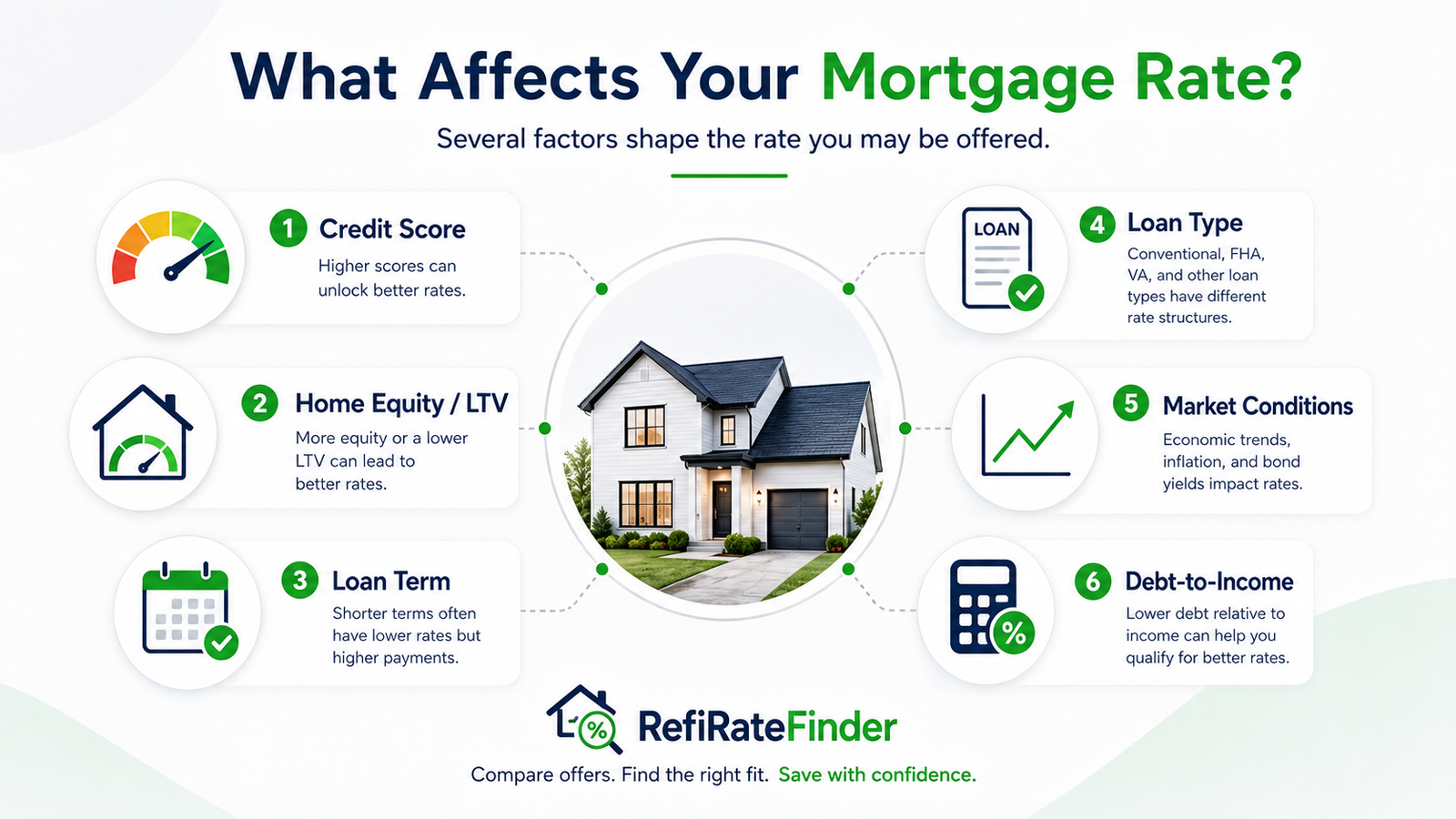
These are the main levers lenders weigh when pricing a loan — some you control, some you don’t. The CFPB breaks down similar factors if you want the regulator’s own explanation alongside ours.
Credit score
Higher scores typically unlock lower rates. Even a jump of 20–30 points into a higher tier can meaningfully change your offer.
Loan-to-value ratio
The more equity you have relative to your home’s value, the less risk a lender is taking on — which often means a better rate.
Loan term
Shorter terms (15-year vs. 30-year) usually carry lower rates, but higher monthly payments since you’re paying it off faster.
Loan type
Conventional, FHA, VA, and jumbo loans are each priced differently based on the risk and guarantees behind them.
Broader market conditions
Rates track economic factors like inflation and Federal Reserve policy — this part is outside anyone’s individual control.
Debt-to-income ratio
Lenders weigh how much of your income already goes toward debt when deciding how much risk your loan represents.
How loan types typically compare
Once you know which mortgage rate factors apply most to your situation, the loan type you choose is the next big lever. Compare real offers on our refinance page or home equity page to see how these tendencies play out for you specifically.
| Loan type | Rate tendency | Best fit for |
|---|---|---|
| 30-year fixed | Higher rate, lowest payment | Long-term stability, lower monthly cost |
| 15-year fixed | Lower rate, higher payment | Paying off faster, less total interest |
| Adjustable-rate (ARM) | Lower rate initially, can change later | Shorter-term ownership plans |
| FHA | Competitive rate, added mortgage insurance | Lower credit scores, smaller down payments |
| VA | Often the most competitive rate available | Eligible veterans and service members |
Rate questions, answered
Why do rates change every day?
Mortgage rates track bond markets and broader economic data, which shift daily. Lenders adjust their pricing in response, sometimes more than once a day.
Why did I get a different rate quote than my neighbor?
Rate quotes are personalized to credit score, loan amount, property type, down payment or equity, and loan type — two people applying the same week can see meaningfully different offers.
Should I wait for rates to drop before refinancing?
Nobody can reliably predict short-term rate movement. Many homeowners instead compare their current rate to what’s available now, and decide based on today’s numbers rather than trying to time the market. If a move makes sense today based on your specific mortgage rate factors, waiting on a hypothetical future drop carries its own risk and opportunity cost.
Is the rate I’m quoted the rate I’ll actually get?
Initial quotes are typically estimates based on the information you provide. Your final rate is confirmed after the lender verifies your credit, income, and property details during underwriting.